# How to Find, Brief and Manage a UK Tradesperson (Without Getting Burned)
Most UK homeowners pick a tradesperson the way they pick a restaurant — a website review, a friend's offhand recommendation, a bet. That works about half the time. The other half is why Citizens Advice receives tens of thousands of complaints annually about rogue traders. This post is the UK homeowner's complete guide to hiring well — how to vet a trade before they arrive, how to brief the job properly, how to pay in a way that protects both sides, and what to do when it goes wrong.
If you only want the top-line rule: find three candidates, check all three against a recognised register, ask for proof of insurance, get written quotes with a scope attached, never pay the full amount upfront, and keep every piece of paperwork. Everything else is detail. But the detail matters, because the homeowner who skips one of those steps is the one on hold with Citizens Advice six months later.
---
## Why Finding a Good Trade Is Harder Than It Should Be
Three structural reasons hiring a UK tradesperson goes wrong more often than it should:
- **The market is fragmented.** The majority of UK construction firms are sole traders. Most jobs change hands once or twice during scheduling. There's no equivalent of a hotel star rating that works across the whole industry.
- **The good trades are busy.** Reliable, insured, registered traders are booked months in advance. Homeowners who need someone this week end up choosing from the pool that happens to be available — which is a biased selection.
- **Reviews are easy to game and hard to verify.** Review platforms depend on traders feeding reviews back into them; homeowners rarely leave balanced feedback after a good job, and the unbalanced feedback that does show up is easy to dispute.
Against all of that, the good news is that most rogue-trader problems trace back to a handful of specific warning signs — most of which you can spot before hiring.
---
## Step 1 — Decide What You Actually Need
Before calling anyone, write down what you want done. Sounds obvious; most people don't. The brief doesn't need to be professional — a list of the rooms, the work you want, the finish you expect, a rough budget range, and a rough timeline gets you 90% of the way.
Distinguishing between types of trade is also worth doing upfront:
- **General builder** — handles multi-trade projects (extensions, loft conversions, whole-house refurbishments). Usually subcontracts the specialists.
- **Specialist single-trade** — plumber, electrician, roofer, plasterer, decorator. Hired direct.
- **Handyman** — odd jobs under the level where specialist registration is needed. Best value for small jobs, usually not appropriate for structural, gas, or notifiable electrical work.
- **Architect / designer** — for anything requiring plans, planning permission, or significant structural change.
- **Project manager / contract admin** — for bigger jobs where coordinating ten subcontractors yourself is impractical.
Match the trade to the job. Hiring a specialist for a small general job is expensive; hiring a generalist for a specialist job is dangerous.
---
## Step 2 — Find Three Candidates
The principle: always get three. Always. The gap between the best of three and the only one you spoke to is where most overcharging and most bad work lives.
### Where to Find Candidates
- **Recommended by a neighbour or local friend** who's had comparable work done — the gold standard. Ask what went well, what went badly, and what the final cost was against the estimate.
- **TrustMark** (trustmark.org.uk) — the government-endorsed quality scheme. Every registered firm has been vetted for technical competence, trading standards, and customer service. Arguably the single best place to start for any non-trivial job.
- **Which? Trusted Traders** — Which? magazine's vetted list. Strong vetting, smaller pool than some others.
- **Checkatrade, MyBuilder, Rated People** — the big aggregator platforms. Useful for finding options quickly; the vetting is lighter than TrustMark or Which?, and reviews are gamed more frequently. Use as a starting point, not a final arbiter.
- **FMB (Federation of Master Builders)** — trade body membership is a positive signal for builders specifically.
- **Registration bodies for regulated work** — Gas Safe Register for gas, NICEIC or NAPIT for electrical, FENSA or Certass for windows. Non-registered operators doing regulated work is illegal, and any quote from one should be declined on that basis alone.
- **Local architect or surveyor** — if you have one from a previous job, they usually have a book of trusted builders.
### What to Give Each Candidate
The same brief, written down, plus site access. Verbal briefs produce wildly different quotes that aren't comparable.
---
## Step 3 — Vet Each Candidate Before They Come Round
Before the site visit, check:
- **The relevant register.** Gas Safe, NICEIC, NAPIT, TrustMark, FMB — whichever applies. Don't take a business card at face value.
- **Companies House**, for limited companies. Check date of incorporation, directors, any recent name changes, any compulsory strike-off history.
- **The trading name** against rogue trader alerts from your local Trading Standards.
- **Public liability insurance.** Minimum £1m; £2m is standard for builders, £5m for anything structural. Ask for proof.
- **Employer's liability** if they'll have anyone on site working for them.
- **VAT registration status** — relevant if the job is over the current VAT threshold.
Doesn't take long. Saves a great deal.
---
## Step 4 — The Site Visit and Quote
Every candidate should visit the site before quoting on anything non-trivial. A quote produced without seeing the property is a guess and will change.
### What Good Looks Like
- They turn up when they said they would. If they're late and don't call, that's a signal.
- They ask questions about the use case, not just the dimensions. "Who uses this room?" "How often?" "What went wrong with the last one?"
- They look at what's actually there, not just the room. A builder quoting for an extension should check the foundations, the drainage, the existing load paths, the meter box locations.
- They take notes, ideally photos.
- They're honest about what they don't know and name the specialist they'd bring in for it.
### What Red Flags Look Like
- Quote on the back of a business card
- Reluctance to show proof of insurance
- Asking for a large cash deposit on day one
- Pressure to start immediately
- Lack of written scope — "we'll sort it out as we go"
- Disparaging the previous trade without having seen the work
- No VAT on a quote over the VAT threshold from a well-established business
### The Quote
Ask for the quote in writing with:
- A detailed scope of works
- Line items with costs (labour and materials broken out where possible)
- Start and completion dates, including any staged milestones
- Payment schedule
- Materials specifications (make, model, grade — "a combi boiler" isn't enough)
- Any exclusions or assumptions
- Warranty on labour
- The trader's insurance and registration details
If it's a vague one-line total, send it back and ask for detail. If they won't give it, don't hire them.
---
## Step 5 — Compare the Three Quotes
You're looking for three things:
- **The scope is the same.** Different quotes with different scopes aren't comparable. If one quote is materially cheaper because it's left out the plastering, that's not saving money — it's deferred cost.
- **The price reflects the work.** Very cheap quotes are either loss-leaders, missing something, or from someone who'll disappear halfway through. Very expensive quotes often reflect a busy firm that doesn't really want the job.
- **The trader is someone you'd want in your home for weeks at a time.** The trader who communicates well and treats you with respect is the one you want when something unexpected comes up mid-job — which it always will.
The middle quote from the candidate you trust most is often the right call.
---
## Step 6 — Before Work Starts: The Contract and the Scope
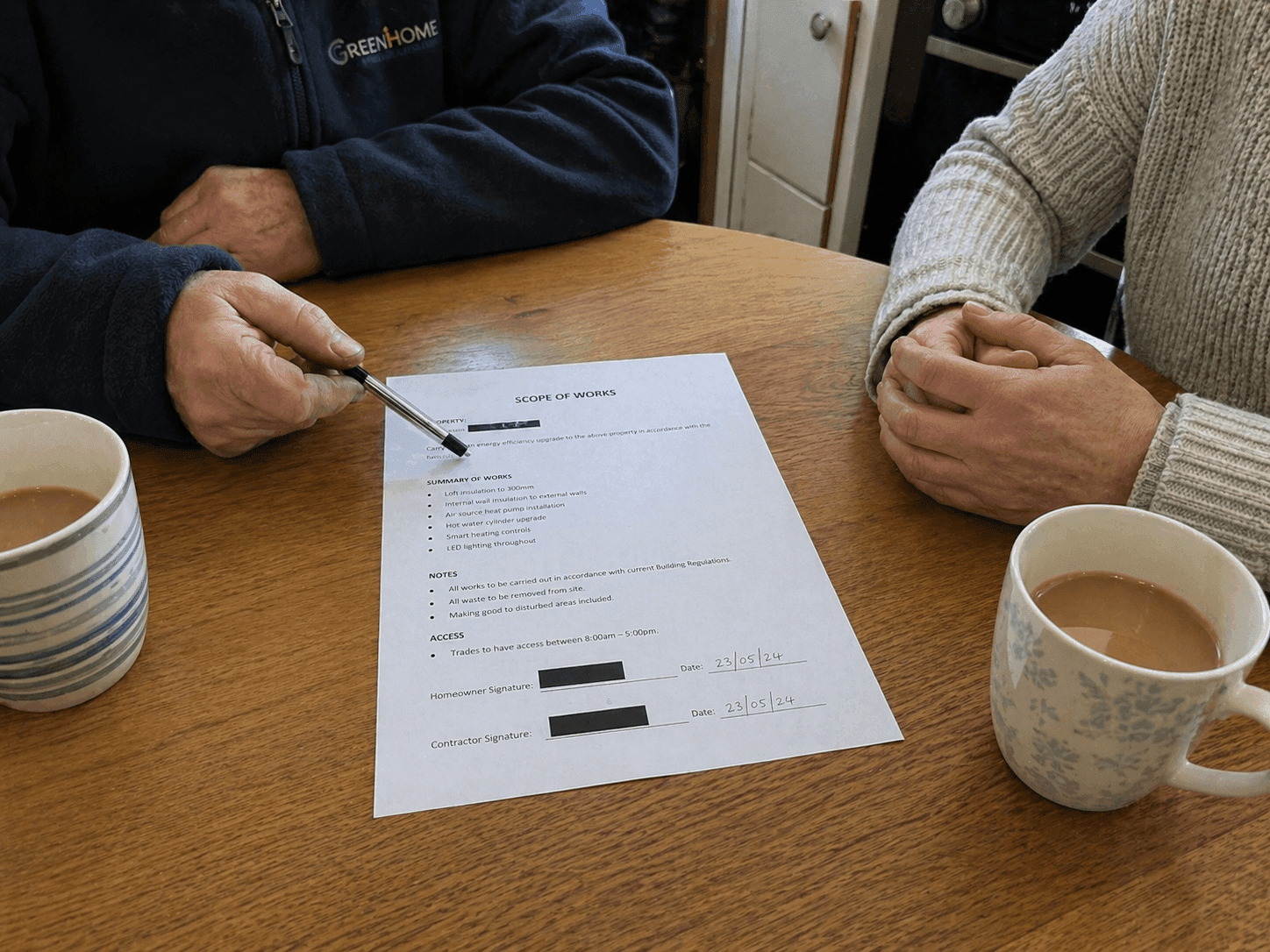
For any job over a few hundred pounds, get a written agreement. For any job over a few thousand, that agreement should be substantive — the scope of works, the price, the payment schedule, the start and completion dates, and the dispute process. Many trades have their own template; the FMB provides one for members, and JCT contracts (Minor Works Agreement) are industry-standard for bigger jobs.
**The scope of works is the single most valuable document in the relationship.** It defines done, and without a clear definition of done, disputes are inevitable.
A deposit of up to 30% of the job is typical and reasonable, primarily to cover materials ordered in advance. Much more than that and you're taking on risk the trader should be carrying. Anything over 50% should prompt a serious conversation about why.
**Never pay the full amount upfront. Never.**
---
## Step 7 — During the Work: Staying Engaged Without Being in the Way
Good trades communicate proactively. Bad ones go quiet. Homeowners who stay lightly engaged get better outcomes than those who either micromanage or disappear for a fortnight.
A weekly ten-minute check-in at the end of Friday is usually enough — what's been done this week, what's next, any blockers, any decisions the homeowner needs to make. For bigger jobs, a shared WhatsApp or email thread for photos of progress works well.
**Flag concerns immediately, not after.** If you think the electrician is running cable through a place that doesn't make sense, ask before the plasterboard goes up. The cost of asking is zero; the cost of fixing it after finish is significant.
**Log additional work in writing.** "While we were in there, we noticed X and recommend doing Y — that'd add £ZZZ and three days to the job." Document that exchange by email or message. Verbal agreements about extra work are the single biggest source of end-of-job disputes.
Don't pay staged payments until staged work is genuinely complete. The milestone gets ticked because the work defined for it is done, not because the trader is ready for the money.
---
## Step 8 — Completion, Snagging, and Final Payment
On completion:
- **Walk the job with the trader.** Agree a snagging list — the small unfinished items or defects that need correcting.
- **Retain a small percentage** (typically 5%) of the final payment until snagging is done. Industry standard; most decent trades expect this.
- **Get every certificate in writing** the day the work completes. Part P electrical, Gas Safe, Building Control notification, FENSA — whatever applies. These go straight into your Home+ document vault.
- **Get the labour warranty in writing.** Typical UK norms: 12 months on workmanship, longer on specialist items. Insurance-backed guarantees are worth having for damp, roofing, and structural work.
---
## When It Goes Wrong: The Dispute Ladder
Most UK home-improvement disputes follow the same ladder. The further up you go, the more expensive and slower it gets. Settle early if you can.
1. **Direct conversation** — be specific, written, calm. Most disputes resolve here.
2. **Written complaint** with reference to the contract and scope. Include photos, witnesses if any, and a clear ask.
3. **Trade body or scheme complaints process** — TrustMark, FMB, and most registration bodies have complaints procedures. Surprisingly effective for registered trades.
4. **Citizens Advice** — they coordinate with Trading Standards and provide guidance.
5. **Mediation** — Alternative Dispute Resolution schemes are often cheaper than court. JCT contracts have mediation clauses built in.
6. **Small Claims Court** — up to £10,000 in England & Wales, £5,000 in Scotland. Fee-based, doable without a solicitor.
7. **County Court** for larger claims. Solicitor advised.
The single most important piece of evidence at every rung of that ladder is the written scope of works.
---
## Specialist Situations
### Work on Gas Appliances
Non-negotiable: **Gas Safe Register.** Not "I know a guy." Illegal if not registered, and your insurance will deny any claim linked to the work. Verify the engineer at gassaferegister.co.uk the day they arrive.
### Notifiable Electrical Work
Covered by Part P of the Building Regulations. A NICEIC or NAPIT registered electrician self-certifies; an unregistered electrician has to notify Building Control, which is slower and more expensive. Notifiable work (bathrooms, kitchens in some cases, outdoor circuits, new circuits) is not DIY territory.
### Listed Buildings and Conservation Areas
Every trade brought in must be briefed on the special consent requirements. A contractor who has never worked on a listed property will quote too low and deliver work the conservation officer rejects.
### Emergency Trades (Burst Pipe at 11pm on Christmas Eve)
Different economics — you'll pay a premium. Use an insurer-approved emergency network if your home insurance includes home emergency cover (it's usually included but often forgotten). Otherwise, stick to the same vetting principles as much as you can in the moment: register, insurance, written quote once the immediate problem is contained.
### Scotland
Scottish consumer law differs in places (small claims threshold, some contract law nuances). The vetting framework — TrustMark, Gas Safe, NICEIC — applies UK-wide. Trading Standards is the local authority contact point in Scotland too.
---
## How Home+ Handles Trade Jobs
Home+ stores every certificate, receipt, and warranty from every job done to your home. When the next homeowner — or your own insurer — asks what was done, when, by whom, and under what warranty, the answer is a single export. More practically: Home+ reminds you when warranties are expiring, when labour guarantees are running out, and when the next service is due with the same engineer who did the last one.
---
## Frequently Asked Questions
### Is a TrustMark trader always better than a Checkatrade trader?
Not always, but the vetting bar is higher. TrustMark assesses technical competence, trading standards, and customer service; the aggregator platforms are mostly review-driven. Many good trades are on multiple platforms — a TrustMark registration is a strong positive signal, not a guarantee.
### How much deposit should I pay a UK tradesperson upfront?
Up to about 30% of the total is typical for larger jobs, mainly to cover materials. More than that shifts the risk onto you. For small jobs (£500 or so), a deposit isn't usually necessary. Never pay 100% upfront regardless of job size.
### Do I need a written contract for a small home job?
A written scope and price is always worth having. For jobs under a few hundred pounds, an email confirming what you agreed is enough. For anything bigger, a proper contract (FMB template or JCT Minor Works) is worth the half-hour to set up.
### What if the tradesperson asks for cash only?
Cash is legal, but a reluctance to issue a VAT-inclusive invoice — when one should apply — is a warning sign. Insist on a written invoice with their registration and contact details. No invoice, no consumer-law protection.
### Who's responsible if a tradesperson damages my home?
Their public liability insurance. Ask for proof before work starts. If damage occurs and they're uninsured, you can claim against them personally, but recovery depends on them having assets — one of several reasons insurance proof is a non-negotiable vetting check.
### Does hiring via a trade register guarantee good work?
No, but it gives you a complaints process that unregistered trades don't. A TrustMark trader who does bad work can have their registration challenged, which incentivises resolution; an unregistered trader has no such incentive. Registered status shifts the bargaining power.
### What's the single best thing I can do to avoid a bad trade?
Get three quotes, check all three against a registration body, and insist on a written scope of works before paying any deposit. Those three steps, done consistently, remove most of the rogue-trader risk.