EPC Ratings Explained — and What the 2026 Reform Actually Changes
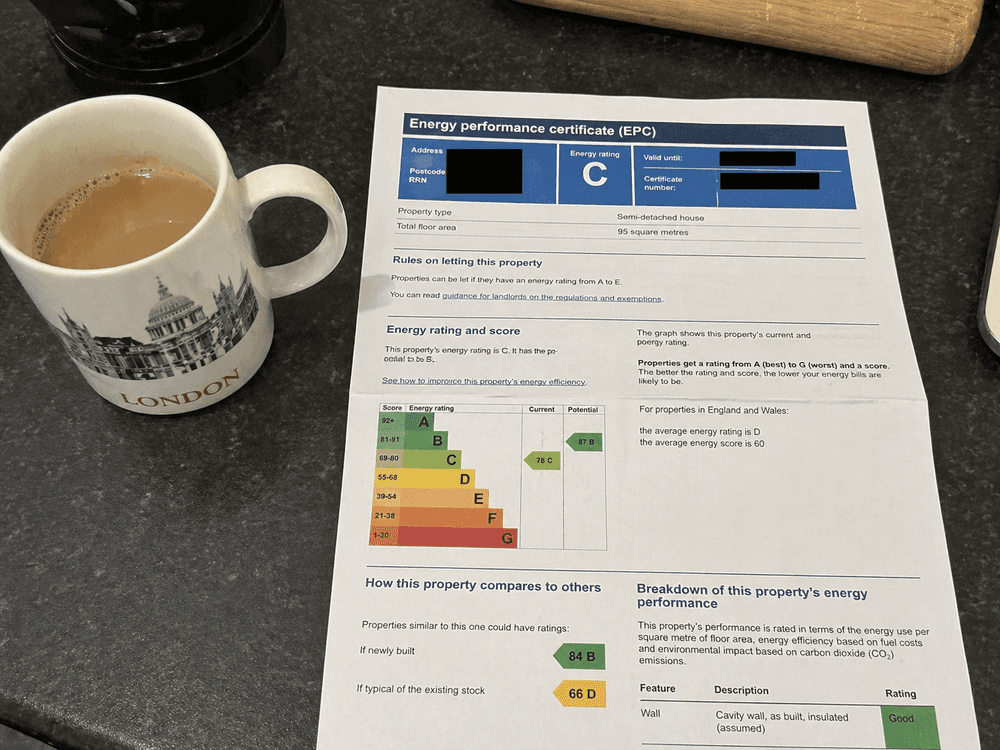
An EPC rating is the single letter you see next to a UK house for sale, A through G, and it's more consequential than most people realise. It shapes what a property costs to run, what grants you can access, what your mortgage lender thinks of it, and from 2026 — when the biggest reform to the system since 2007 is rolling out — how it's communicated entirely. This is the plain-English guide: what an EPC actually measures, how the rating is calculated, what the 2026 reform changes, how long an EPC lasts, and what you can realistically do about yours.
If you only remember three things: your EPC is valid for 10 years from the date of issue, you only legally need one when you sell or let, and the system is moving in 2026 from a single A-G letter to four separate performance metrics. Everything else is detail.
What an EPC Is — and What It Isn't
An Energy Performance Certificate is a standardised government-approved assessment of how energy-efficient a property is. Every EPC covers:
A rating from A (most efficient) to G (least) based on a numerical Standard Assessment Procedure (SAP) score
A breakdown of the fabric of the building (walls, roof, floor, windows)
The heating system and hot water arrangement
Estimated annual energy costs for heating, hot water, and lighting
A list of recommended improvements, with indicative costs and savings
The potential EPC rating if those improvements were made
What it isn't:
A condition survey. An EPC doesn't tell you whether the roof leaks, whether the boiler works, or whether the wiring is safe.
A precise bill prediction. The figures are based on standardised assumptions about occupancy, heating hours, and climate — not your actual usage.
A detailed retrofit plan. It'll tell you "loft insulation recommended," not "loft insulation at this depth using this material for this cost in this exact order."
Think of the EPC as a quick assessment of the fabric and systems of the home, calibrated so every UK property can be compared against every other. That's its purpose: comparability. And that's also why it's been criticised — in pursuit of being comparable, it's sometimes misleading about any specific property.
The A-to-G Scale: What the Letter Actually Means
EPC ratings are driven by a SAP score between 1 and 100+. Here's how the bands work:
A: 92+ — Exceptional. Typically new-build or deeply retrofitted homes, heat pumps, solar, high-grade insulation.
B: 81–91 — Very efficient. Modern well-insulated homes, often gas-heated with high-spec glazing.
C: 69–80 — The new target. Most modern (post-2000) builds land here.
D: 55–68 — Most common band. The average UK home is mid-to-low D.
E: 39–54 — Below average. Often older stock with minimal insulation.
F: 21–38 — Poor. Solid-wall, uninsulated, old boilers.
G: 1–20 — Worst. Historic, unrestored, or wholly uninsulated buildings.
The target of most UK energy policy is to get as much stock as possible to a C or above. That target has driven landlord legislation, influences Warm Homes grants and ECO4 funding eligibility, and increasingly shapes mortgage rates via green mortgage products.
How the Rating Is Actually Calculated
The SAP score is produced by a Domestic Energy Assessor (DEA) visiting the property and inputting data into a government-approved calculator. The inputs include:
Fabric: wall type (cavity / solid / timber / steel), whether cavity walls are filled, loft insulation depth, floor type, glazing age and type
Heating system: boiler make, model, age, fuel type, efficiency rating
Controls: whether there's a programmer, room thermostat, TRVs
Hot water: cylinder (insulated?) or combi, immersion, solar thermal
Ventilation: extract fans, MVHR systems
Renewables: solar PV, solar thermal, heat pumps, wind
Floor area and dimensions from a room-by-room measurement
The SAP calculator produces a number. That number maps to the A-G band.
What you might find counter-intuitive: SAP is heavily shaped by cost. Because mains gas has been cheap per kWh historically, gas-boilered homes often score better than heat-pump homes of equivalent thermal performance — even though the heat pump home has much lower carbon emissions. Critics have been flagging this for years. The 2026 reform addresses it head-on.
What the 2026 Reform Actually Changes
The reform is the biggest overhaul of the EPC system since it launched in 2007. Rather than a single A-G letter, UK EPCs are moving to four separate performance metrics, each shown alongside the others on the certificate. The stated intent is to stop the single letter from hiding trade-offs and to give homeowners, buyers, landlords, and lenders a richer view.
The Four Metrics
1. Fabric performance. How well the building envelope performs — walls, roof, floor, windows, air-tightness. This isolates the "bones" of the property from the heating system you happen to have installed.
2. Heating system performance. The efficiency and carbon intensity of the installed heating and hot water system. Heat pumps score here on their strengths (carbon) rather than being penalised on cost.
3. Smart readiness / controls. Whether the home has the smart meters, thermostats, and control systems needed to run efficiently. Reflects the increasing importance of demand-shifting and time-of-use tariffs.
4. Energy cost. What the home will actually cost to run in typical use, under standardised assumptions. Closest to the old SAP cost metric.
Each metric gets its own score. The old A-G single letter survives in a modified form as an overall summary, but the four metrics are the headline and are what listings, mortgages, and grants are expected to increasingly reference.
Timeline
New certificates issued from the start of the rollout use the four-metric framework. Existing certificates remain valid until their 10-year expiry, and transition guidance covers how mortgages, grants, and MEES rules translate between old and new certificates.
Why This Matters for UK Homeowners
For most owner-occupiers not planning to sell, the reform is administratively invisible — your existing EPC stays valid until it expires. Where it bites:
Sellers — your listing will display four metrics, not one letter. Some homes that looked "middle-of-the-road D" under the old system will show a strong fabric score with a weak heating metric, or vice versa.
Buyers — you can assess trade-offs you couldn't before. A home with a great fabric score and an old boiler is an easy upgrade story; one with poor fabric and a brand-new heat pump isn't.
Homeowners planning improvements — the four-metric framework makes the payoff of specific improvements more visible. Cavity wall insulation improves your fabric score; a heat pump improves your heating score.
Grant and mortgage thresholds are expected to transition over the phase-in period. If you're planning a major retrofit, check whether the grant you're applying for has migrated to the new framework or still uses the old bands.
How to Check Your Property's Current EPC
Most UK properties have an EPC already on the national register, because one was produced when the property was last sold, let, or retrofitted. Check:
England, Wales and Northern Ireland: find-energy-certificate.service.gov.uk
Scotland: scottishepcregister.org.uk
Enter the postcode, find the address, and you'll see the full certificate as a PDF. No account needed, no payment.
If there's no EPC on file, the property either hasn't been sold or let since 2007 (rare) or the certificate has expired. To get a new one, book a Domestic Energy Assessor. Cost: typically £60–£120 for a 3-bed.
How Long an EPC Lasts
10 years from the date of issue. No matter what you do to the property, the certificate is valid for 10 years, and you don't legally need a new one until the old one expires — unless you sell or let the property before then, in which case a valid certificate is a legal requirement at the point of marketing.
Worth knowing:
You can commission a new EPC at any time, which supersedes the old one. Common reasons: you've upgraded insulation, installed a new boiler, fitted solar, and want the certificate to reflect the improvement.
There's no central enforcement of the 10-year rule for owner-occupiers. If yours expired in 2022 and you're not selling, nothing happens.
Landlords have additional EPC obligations and timing rules that homeowners don't.
How to Improve Your EPC Rating
Most UK homes sit at D or E. Moving to C — the current target — usually requires a combination of fabric and systems improvements, not a single silver bullet. A fabric-first order of operations is standard industry advice.
1. Insulation (Fabric)
Loft insulation is the cheapest, highest-impact starting point if you're below 270mm of loft depth. Cost: £400–£1,200 installed for a typical 3-bed.
Cavity wall insulation adds several SAP points for homes with empty cavities (most UK houses built between ~1920 and ~1995). Cost: £400–£2,000 depending on property size.
Solid wall insulation is the big-ticket item for older properties. Internal or external, both expensive, both transformational for EPC. Typical range: £8,000–£22,000.
Floor insulation and draught-proofing round out fabric work. Individually small, cumulatively significant.
2. Heating System
Replacing an old non-condensing boiler with a modern A-rated condensing boiler is usually a clear EPC win.
Heat pumps are a longer conversation. Under the old SAP system, they sometimes gave weaker EPC results than a new gas boiler despite being far lower-carbon — one reason for the 2026 reform. Under the new heating-system metric, heat pumps score well.
3. Controls and Smart Readiness
Simple additions — a programmer, room thermostat, TRVs on every radiator — are cheap SAP points and relevant to the new smart-readiness metric.
4. Renewables
Solar PV adds SAP points and will increasingly help the new energy cost metric.
5. Hot Water
An insulated hot water cylinder, or a move to combi, is a modest but real improvement for older systems.
What to Do in What Order
A lot of homeowners start with the most visible upgrade — new boiler, or solar — and skip insulation. That's nearly always the wrong order. Fabric first means you heat less; systems improvements then move a smaller heat demand more efficiently. Every credible retrofit advisor will say the same.
What EPC Improvements Cost — and What They Pay Back
| Improvement | Indicative Cost |
|---|---|
| Loft insulation (270mm top-up) | £400–£1,200 |
| Cavity wall insulation | £400–£2,000 |
| Solid wall insulation | £8,000–£22,000 |
| New A-rated boiler (installed) | £2,500–£4,500 |
| Air source heat pump (minus BUS grant) | £8,000–£14,000 |
| Solar PV (4kW system) | £5,000–£9,000 |
| Double glazing (whole house) | £5,000–£14,000 |
Payback periods vary enormously with fuel prices. Insulation payback is usually fast (a few years); heat pump payback is slower but improves as gas prices rise; solar payback hovers in the 8–12 year range under current UK conditions.
Grants and Funding to Know About
Several UK grants are linked to EPC ratings and are expected to transition over the 2026 reform period:
Boiler Upgrade Scheme (BUS) — grant toward heat pumps and biomass boilers
ECO4 — funding for low-income households to improve poor-EPC homes
Warm Homes: Local Grant (where available) — replaces Green Homes Grant in various forms
Home Upgrade Grant (HUG) — for off-gas-grid, lower-EPC homes
Green mortgages — lower rates for homes above specific EPC bands, or cashback for improvements that raise an EPC
Check current eligibility on gov.uk — programmes change frequently and eligibility is often postcode- and income-dependent.
Common Misconceptions
"My EPC is out of date because I changed the boiler." No — the certificate is valid for 10 years regardless. You may want a new one to reflect the upgrade, but you aren't required to have one.
"I need an EPC to sell even with a valid one." No — if your existing EPC is less than 10 years old, that's the certificate your buyer uses.
"An EPC tells you carbon emissions." Sort of. The old system was primarily cost-based. The new four-metric system makes carbon and cost more distinguishable.
"I can't improve my EPC because I'm in a period / listed property." Listed buildings have genuine constraints, but fabric improvements that don't alter the external appearance — secondary glazing, internal insulation, improved draught-proofing — are often permitted. Talk to your local conservation officer before assuming you can't do anything.
"A heat pump will automatically improve my EPC." Under the old SAP system, sometimes — often only marginally. Under the 2026 framework, heat pumps score materially better. Timing matters.
How Home+ Handles Your EPC
Home+ stores your EPC alongside your property record, tells you when it expires, and flags improvement opportunities against your specific property and rating. When the 2026 reform changes the certificate format, your certificate gets auto-updated in the vault and the improvement recommendations rebalance to the four-metric framework. You can see the before/after of any planned improvement in a single view, which is also what grant applications and mortgages will increasingly ask for.
Sign up to Home+ free to add your EPC and set up the reminders that make sure yours doesn't quietly lapse.
Frequently Asked Questions
What's the EPC rating I actually need to hit?
For owner-occupiers, there is no legal minimum. For private landlords, policy is moving toward EPC C for new tenancies — check the current government position as this has evolved. Most UK policy and mortgage pricing is nudging toward C or above.
Do I need a new EPC if I change my boiler?
No — it's valid for 10 years. But you may want one if you're trying to qualify for a grant or a green mortgage that has an EPC threshold.
Why does my EPC recommend things I've already done?
Because the assessment is a point-in-time snapshot based on what the assessor observed. If you've done work since, the certificate won't reflect it. A new EPC costs £60–£120 and fixes this.
Can I challenge my EPC rating if I think it's wrong?
Yes. Contact the assessor who produced it; they can revisit and reissue. If there's a genuine dispute, the accreditation body (e.g. Elmhurst, Stroma) has a complaints process.
How does the 2026 reform change grant eligibility?
Grants that currently use the old A-G band thresholds are transitioning to the new framework during the rollout. Eligibility is expected to translate rather than reset, but the specific metric a given grant uses may change. Check the grant's own guidance before applying.
What's the single biggest EPC improvement I can make cheaply?
For most UK homes below D, loft insulation is both the cheapest fabric improvement and the one with the clearest EPC uplift.
Does an EPC cover the garage or outbuildings?
Generally, no — EPCs cover heated, habitable spaces. An attached garage that has been converted and is heated may be included if it forms part of the main dwelling.
I'm in Scotland. Are the rules different?
EPC rules operate separately in Scotland via the Scottish EPC Register, with their own assessor accreditation system and reform timeline. The fundamentals — A-G rating, 10-year validity, needed at sale and let — are the same. Check the Scottish EPC Register for nation-specific specifics.