# How to Organise Your UK Home Documents (and Why It Saves You Thousands)
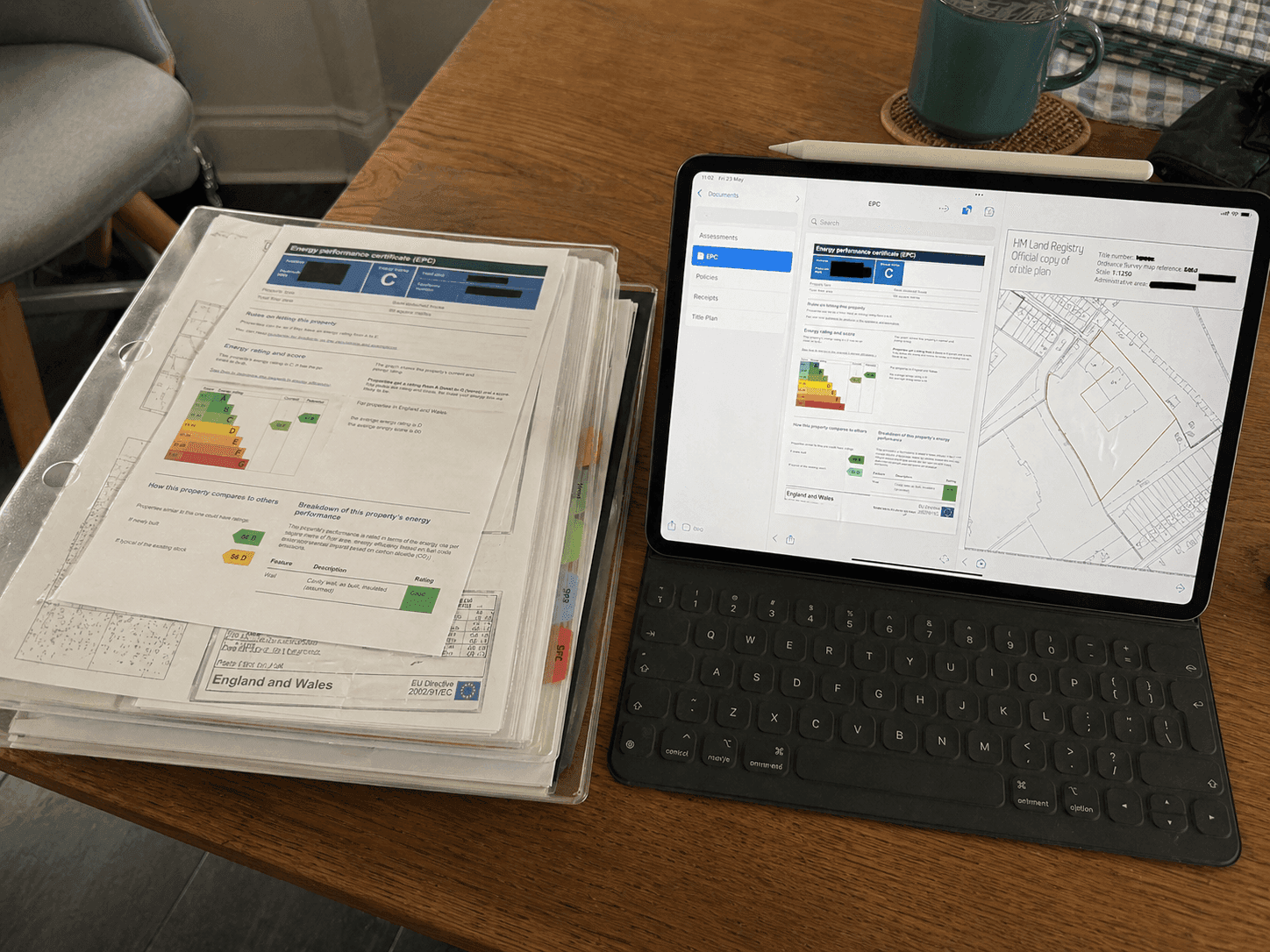
Most UK homeowners can't find their EPC, their boiler manual, or the last gas safety check when they need them. Every one of those documents has a real-money consequence when it goes missing — a delayed sale, a voided warranty, a failed mortgage application, a refused insurance claim. This post is the UK homeowner's complete guide to organising house paperwork: what to keep, what to bin, how to digitise, what to hand over when you sell, and how to build a system that stops the stuff going missing in the first place.
If you only want the short version: keep everything that proves what you own, what you've done to it, and who's responsible if something goes wrong — and scan it. The minute you move it from a drawer to a searchable, dated digital file, the system works. Home+ is built to be that file, but the principles apply whether you use Home+, Dropbox, a filing cabinet, or a biscuit tin (don't use a biscuit tin).
---
## Why This Matters More Than Homeowners Realise
The cost of losing a single document rarely lands in one obvious bill. It shows up as a delay at the point of sale, a warranty claim refused because the service history is incomplete, an EPC-contingent grant application that can't be submitted, a building regs dispute that costs £1,500 in solicitor's time because no one can find the completion certificate.
The typical UK home sale involves over 200 documents changing hands between buyer, seller, solicitors, lenders, estate agents, and surveyors. Anything the seller can produce quickly shortens the chain; anything missing gets referred out for indemnity insurance or replacement and costs time and money.
---
## The Five Categories of UK Home Documents
Every piece of paperwork you'll accumulate as a UK homeowner falls into one of five categories. Organising by category — rather than chronologically or by which drawer you happened to put it in — is the first change that makes the whole system workable.
### 1. Ownership Documents
The paperwork that proves you own the home and sets out your legal rights and restrictions.
- **Title register (TR / title information document)** — the HM Land Registry record of ownership. You can download a copy from gov.uk for £3.
- **Title plan** — the registered boundary, also from HMLR.
- **Transfer deed (TR1)** — the document by which ownership was transferred to you at completion.
- **Previous title deeds** — historical paper deeds, particularly relevant for unregistered properties (roughly 15% of UK land remains unregistered).
- **Leasehold information** (if applicable) — the lease itself, ground rent schedule, service charge accounts, lease extension paperwork, share of freehold certificates.
- **Covenants, restrictions, rights of way, easements** — any limitation on what you can do with the property.
- **TA6 and TA10 forms from your purchase** — the Law Society's seller property information and fittings and contents forms.
### 2. Warranty and Guarantee Documents
Anything that promises a third party will fix something if it breaks.
- **Building warranties** — NHBC, LABC, Premier Guarantee, Checkmate. Typical cover is 10–12 years; the second-period cover (years 3–10) is what matters for most claims.
- **Manufacturer warranties** — boiler, windows, kitchen appliances, solar panels. Often expire on first sale unless specifically transferable.
- **Installer guarantees** — roofing, damp proofing, electrical work, loft conversions. Worth less than manufacturer warranties because installers go out of business.
- **Insurance-backed guarantees** — typically bought with damp / timber / cavity wall work. These survive the installer going bust.
- **Extended warranties on appliances** — usually oversold, but if you have them, file them.
### 3. Compliance and Certificates
Everything that proves the home meets legal and safety standards — a mix of mandatory and best-practice documents.
- **EPC** — valid 10 years, available on the government EPC register.
- **Gas Safety records** — any CP12 from when the property was let, plus annual boiler service records since you bought.
- **EICR** — electrical installation condition report. Homeowners aren't legally required to hold one, but a recent one is an asset at sale.
- **Building Control completion certificates** — for any notifiable work (extensions, loft conversions, window replacements, electrical work in wet areas, boiler replacements). The single most commonly missing document in UK property sales.
- **FENSA / Certass certificates** — for replacement windows and doors since 2002.
- **Part P electrical certificates** — from registered electricians for notifiable work.
- **Planning permission documents** — decision notices, approved plans, discharge of conditions.
- **Chimney sweep certificates** — required by most home insurance policies for properties with open fires or wood-burners.
- **Asbestos surveys** — relevant for older properties or post-work surveys.
### 4. Maintenance and Service History
The running record of what's been done to the home. Often the thing a serious buyer pays most attention to.
- **Boiler service records** — annual, Gas Safe engineer's report, filed by date
- **Appliance service and repair records** — anything over £200 to fix
- **Roof work** — any repair, re-slating, or flashing replacement
- **Damp and timber treatments** — reports, treatment records, certificates
- **Driveway, patio, garden works** — drainage, retaining walls
- **Paint and decoration** — useful to log the paint code for each room for future touch-ups
### 5. Financial and Administrative
The paperwork that keeps the home running from a mortgage, insurance, and utilities standpoint.
- **Mortgage documents** — offer letter, deed of mortgage, any remortgage or product transfer paperwork
- **Home insurance** — buildings, contents, and any additional covers (accidental damage, home emergency, legal expenses)
- **Ground rent and service charge demands** (if applicable)
- **Utility account details** — meter numbers (MPAN for electricity, MPRN for gas), previous bills at change-of-occupier
- **Council tax** — latest bill, band, any exemptions or reductions
- **Water** — metered or unmetered, meter serial number if metered
---
## Paper, Digital, or Both?
Most UK homeowners end up with a hybrid system. The modern answer is: **digital primary, paper secondary** for originals that have legal weight as physical items.
### What You Must Keep as Paper
Very little, actually. A few exceptions:
- Original signed deeds for unregistered land
- Lease documents for leasehold property, where the original has been signed and stamped
- Some historical warranties that require the original physical certificate for claims
Beyond that, scanned copies satisfy almost every situation. Your solicitor will tell you if something needs to be kept as a physical original — listen when they do.
### What Benefits Most from Digitising
Everything else. Specifically:
- **Compliance certificates** — you'll need to produce these in seconds during a sale or when applying for a grant
- **Warranty paperwork** — searching for "boiler warranty" in a well-organised digital file is a three-second job
- **Service history** — easier to keep continuous over many years
- **Receipts for improvements** that might feed into the cost base for Capital Gains Tax if you ever let or sell a second home
---
## What a Good Digital System Looks Like
Five rules, regardless of whether you use Home+, a cloud folder, or a Notion page:
1. **Consistent naming.** Use a format like `2024-03-15 Boiler service — Worcester Bosch Greenstar 30i — John Smith Gas Safe.pdf`. Date first (ISO 8601 so it sorts chronologically), subject second, details third.
2. **Category folders, not year folders.** Ownership / Warranties / Compliance / Maintenance / Financial. Year goes in the filename.
3. **Backed up.** Cloud storage with versioning, or a physical external drive plus cloud. Not a single drive, not a single app without export.
4. **Scanned at readable quality** — 300dpi minimum, PDF not JPG, OCR if possible so you can search inside.
5. **A single dated inventory page** that lists every document you hold, when it was added, where the physical original is, and when it expires. Home+ generates this automatically from the documents you upload.
---
## Retention — How Long to Keep Which Documents
| Document Type | Keep For | Why |
|---|---|---|
| Title deeds, conveyances, covenants | Permanently | Legal ownership record |
| Planning permission decisions | Permanently | Development rights proof |
| Building Control completion certificates | Permanently | Legal compliance proof |
| NHBC / structural warranties | Until expired + 6 years | Limitation period after expiry |
| Boiler service records | 6 years or life of boiler | Warranty + insurance claims |
| EICR | Until superseded | Current validity only |
| EPC | 10 years from issue | Statutory validity |
| Gas safety records (from letting period) | 2 years minimum, 6 recommended | Landlord obligations retention |
| Home insurance policies | 6 years from end of cover | Limitation period on claims |
| Utility bills | 2 years | Rarely needed beyond tax basis |
| Mortgage statements | Life of mortgage + 6 years | Discharge proof |
If you're not sure, keep. Digital storage is effectively free; the cost of binning something you later need is not.
---
## The Buyer's Side: What You'll Need When You Move In
Coming into a UK home, the paperwork you should receive from the seller's solicitor includes:
- Transfer document (TR1 or equivalent)
- Official copies of the title register and title plan
- TA6 and TA10 forms
- Replies to enquiries
- Any guarantees, planning permissions, Building Control certificates, warranties, FENSA certs, Part P certs
- Gas Safety record and EICR if available
- EPC
- Lease (if leasehold) and service charge / ground rent statements
The "completion pack" your solicitor sends you is often the single most valuable piece of paperwork you'll ever receive as a homeowner. File it the day you get it. Most UK homeowners pile it on the kitchen counter, move it to a drawer, and then spend a stressful week finding it three years later when they remortgage.
---
## The Seller's Side: What You'll Hand Over
When you sell, you'll be asked to produce:
- A full TA6 and TA10 disclosure
- Copies of every Building Control, planning, FENSA, and Part P certificate for work done while you owned the property
- The current EPC (get a new one if yours has expired)
- Gas Safety records and service histories
- Warranties and guarantees (some are transferable, some aren't)
- Insurance claims history (relevant for subsidence, flood, fire)
- Any disputes or disagreements with neighbours or the freeholder
The seller who hands over a clean, complete document bundle sells faster and closer to asking price. The seller who has to hunt, apologise, and apply for indemnity insurance to paper over gaps does not. Organising the file from day one is the cheapest uplift to your eventual sale price.
---
## What Most Homeowners Forget to Keep
Five common omissions, from surveyor conversations and solicitor feedback:
- **Receipts for kitchen and bathroom installations.** Relevant for warranties, Capital Gains Tax (on second homes), and proof of improvement at sale.
- **Garage conversions without Building Control sign-off.** If the previous owner converted without approval, the problem becomes yours. Demand the certificate at purchase.
- **Neighbour consents for shared driveways, party walls, or boundary agreements.** Informal arrangements evaporate when neighbours change.
- **Photographs of work in progress.** Photos of the joists before the loft conversion was boarded, or the plumbing before the wall was plastered, are invaluable to future tradespeople.
- **Chain of custody for guarantees.** Many installer guarantees are personal — they die when the installer leaves the business or you leave the house. Insurance-backed guarantees (IBGs) survive; ordinary ones don't. Check which you have.
---
## Special Cases
### Listed Buildings
Add a "listed buildings consent" section to your compliance category. Any work on a listed building requires consent separately from planning permission. Keep original listing documents, consent decisions, and any heritage impact assessments — all permanent keepers.
### Conservation Areas
Your local authority's conservation officer holds the relevant records. Keep any consent correspondence for exterior work (even painting, in some conservation areas).
### Shared Ownership and Leasehold
Additional documents to track: share valuations, staircasing arrangements, ground rent schedules, major works consultations under section 20 of the Landlord and Tenant Act 1985, service charge budgets and accounts.
### Unregistered Land
Roughly 15% of UK land remains unregistered at HM Land Registry. For those properties, paper deeds are the only evidence of ownership. Keep the originals safe; consider first-registration if your mortgage doesn't require it, so that HMLR rather than your bottom drawer holds the record.
### Scotland
Scottish property law runs separately. The Land Register of Scotland is the equivalent of HMLR; Property Enquiry Certificates, Home Reports, and dispositions replace some English paperwork. A Scottish solicitor should sanity-check this document list for north-of-the-border accuracy.
---
## How Home+ Handles It
Home+ is built to be the file. Upload a document — EPC, gas safety record, boiler manual — and Home+ categorises it, extracts key fields (expiry dates, makes and models), and files it against your property. Expiry nudges fire automatically; you don't need to remember when your EPC runs out. At sale, you export the whole bundle in one click and hand it to your solicitor. The purpose is to remove "I can't find it" from the homeowner vocabulary.
Sign up to Home+ free and add your first document in 30 seconds.
---
## Frequently Asked Questions
### Do I have to keep physical copies of UK home documents?
Very few documents require you to hold the original paper version. Most registered title work, warranties, and compliance certificates are fine as scanned PDFs. Original signed deeds for unregistered land and some leasehold documents are exceptions — check with your solicitor.
### How long should I keep utility bills and council tax demands?
Two years is usually sufficient. Beyond that they rarely have any legal weight and are superseded by the next bill.
### What's the single most-missed document in UK property sales?
Building Control completion certificates for work done by a previous owner — typically extensions, loft conversions, or boiler replacements. Ask for them at purchase; you'll regret it if you don't.
### Can I get a replacement copy of my title deeds?
Yes, from HM Land Registry at gov.uk. Official copies cost £3 per document. Most registered properties do not need the paper deeds — the registered title is the legal record.
### I've just had a loft conversion. What should I file?
Planning permission decision (or permitted development certificate), Building Control notification and completion certificate, structural engineer's calculations, electrical Part P certificate, fire safety compliance, and any specialist certificates for trickle vents or glazing. File all of them under Compliance the week the work finishes.
### Does Home+ accept photos or only PDFs?
Home+ accepts photos, PDFs, and live uploads from common scanning apps. The categorisation works for both; PDFs search slightly better because they're OCR-friendly.