# The UK Homeowner's Safety & Compliance Checklist
If you own and live in your home, the law asks less of you than most people think — but the things it does ask matter. Unlike a landlord, a UK homeowner doesn't need an annual CP12 gas certificate, a 5-yearly EICR, or a PAT test on their kettle. What homeowners are legally responsible for is mostly about alarms, building regs when you alter the property, and the duty of care that applies whenever someone else is in your home. The rest of the safety agenda — boiler services, electrical checks, fire precautions — is strongly recommended and practically necessary, but not legally required.
This post covers both. What's legally required, where the lines are, and the "not legally required but you'd be daft not to" items that insurers, mortgage lenders, and surveyors will expect to see. Use it to work out what you actually need to do this year versus what the internet will try to tell you to do.
---
## Homeowners vs Landlords: Why the Rules Are Different
A lot of the UK safety-compliance content online is written for landlords and reposted as if it applies to everyone. It doesn't. If you own and live in your home, **none of the following apply to you:**
- Annual CP12 gas safety record (landlord-only)
- 5-yearly EICR electrical certificate (landlord-only, though strongly recommended for homeowners every 10 years)
- Annual smoke alarm testing as a legal duty (there's no homeowner equivalent)
- Portable Appliance Testing (PAT) — never was a legal requirement for anyone, incidentally
- EPC at a set interval (homeowners only need one when selling or letting)
What homeowners do have to do is covered below, pillar by pillar.
---
## Gas Safety
### What the Law Requires of Homeowners
Nothing, as long as you're not letting the property. You don't need a CP12. You don't need annual inspections. You are, however, expected to maintain gas appliances so they are safe to use — and you remain criminally liable if you install or modify gas appliances yourself without being Gas Safe registered.
### What You Should Actually Do
**Service your boiler annually.** Not because the law says so, but because:
- Almost every boiler warranty requires it. Skip a service and a £2,500–£3,500 boiler becomes your problem the moment it fails.
- A service will catch a carbon monoxide leak before it hurts anyone.
- Your home insurance, in the event of a claim involving the boiler, will ask.
Use a Gas Safe registered engineer — never someone who "does a bit on the side." Check the register at [gassaferegister.co.uk](https://www.gassaferegister.co.uk) before they start. Expected cost: £80–£150.
**Fit a carbon monoxide alarm** in every room containing a gas appliance (or a fossil-fuel appliance like a wood-burner). Test monthly.
**Never DIY gas work.** It's a criminal offence under the Gas Safety (Installation and Use) Regulations 1998 to work on gas pipework or appliances without being Gas Safe registered. That includes moving a cooker.
---
## Electrical Safety
### What the Law Requires of Homeowners
The Building Regulations Part P covers certain electrical work and has applied since 2005. Notifiable work — anything in a bathroom, kitchen (in certain circumstances), outdoors, or involving a new circuit — must be either:
- Done by a Part P registered electrician who self-certifies, or
- Notified to and inspected by your local Building Control Body.
DIY electrical work on non-notifiable areas (a new socket in a living room wall, changing a light fitting) remains legal but must still comply with BS 7671.
### What You Should Actually Do
- **Commission an EICR every 10 years.** It's not legally required for owner-occupiers, but it's the single best non-legal safety check you can do. Expect £150–£300 for a 3-bed and ask for a report with photographs.
- **Get an EICR when you buy.** Many conveyancing surveys skip the electrics entirely. A £200 EICR at purchase is the cheapest insurance policy you'll buy.
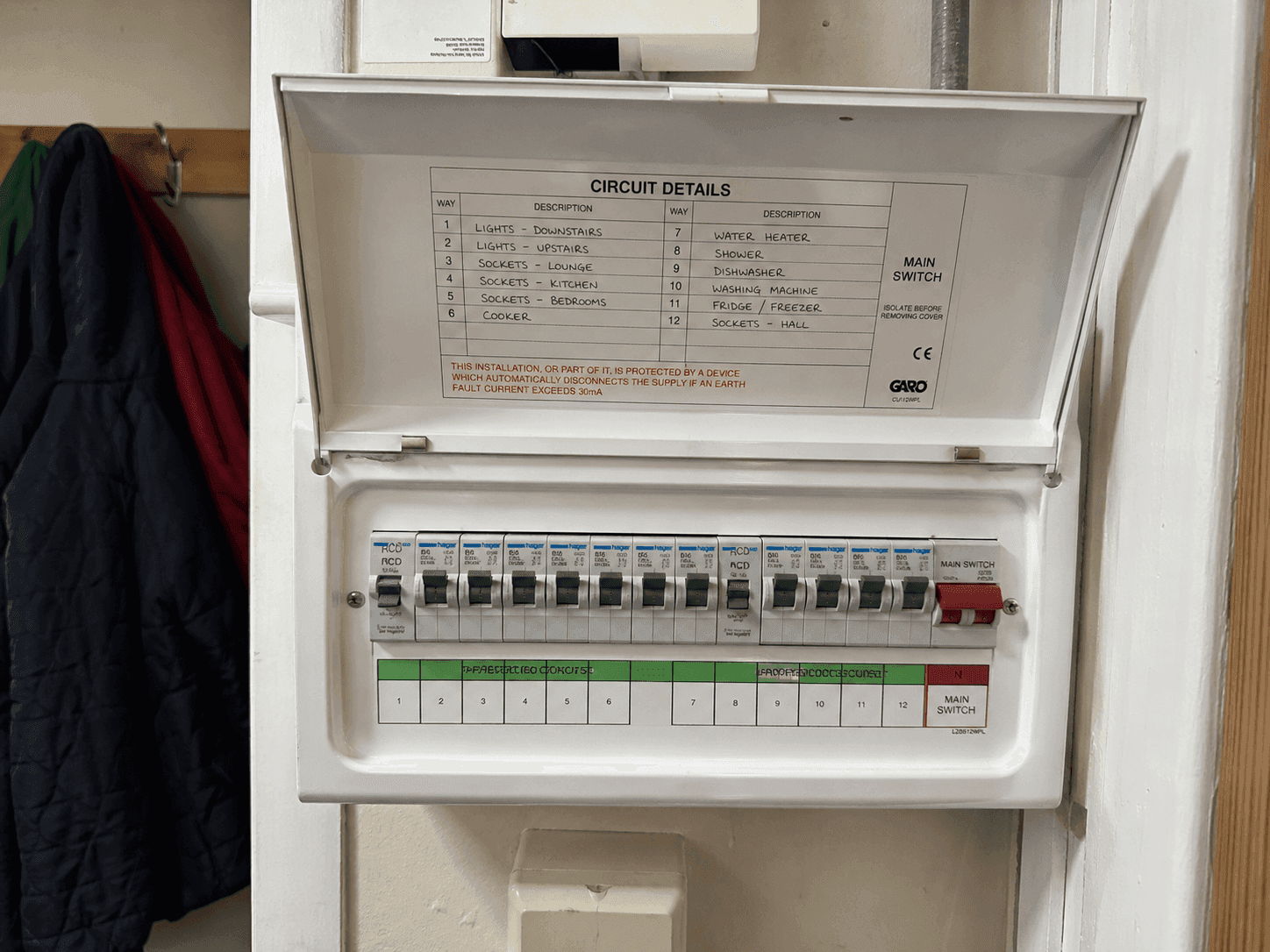
- **Check your RCD protection.** Modern consumer units have RCDs (residual current devices) — the trip switches that protect against electric shock. If your fuse board is old (no coloured trip switches, old wire-fuse sockets), it's due for replacement.
- **Don't DIY notifiable work.** If in doubt, call a NICEIC or NAPIT registered electrician.
- **Know your consumer unit.** Label every breaker. Know which controls the immersion, which the kitchen sockets, which the upstairs lights. At 2am with a burst pipe near a light fitting, you need to know in 10 seconds.
---
## Fire Safety and Alarms
This is the area where homeowner rules have tightened most in recent years, and where a lot of people are unclear about what applies.
### Smoke Alarms
Homeowners are not legally required to have a specific number of alarms in a pre-existing property. However:
- **New builds** (since 1992) must comply with Building Regulations Part B, which requires interconnected mains-wired smoke alarms on every storey.
- **Major alterations or extensions** trigger the same requirement when the work is notified to Building Control.
- **Scotland has stricter rules** than England and Wales: since February 2022, every Scottish home (owner-occupied included) must have interlinked smoke alarms in hallways and living rooms, a heat alarm in the kitchen, and a CO alarm where there's a fossil-fuel appliance. If your property is in Scotland, you are legally required to comply.
**What to actually do everywhere in the UK:**
- Smoke alarm on every floor, in hallways or landings
- Heat alarm in the kitchen (smoke alarms in kitchens go off when you make toast — a heat alarm doesn't)
- Interlinked alarms (wireless-linked is fine) so if one goes, they all go
- Test monthly, replace batteries annually if not sealed, replace the entire unit every 10 years
### Carbon Monoxide Alarms
Required in Scotland by law (see above). In England and Wales, Building Regulations Approved Document J requires a CO alarm whenever a new or replacement solid-fuel appliance is installed, and the 2022 amendments for private rented housing extended this — but for owner-occupiers with existing installations, it's strongly recommended rather than required. Fit one anyway, in every room with a gas, oil, or solid-fuel appliance.
### Fire Doors
Fire doors are generally a commercial / rented-flat concern — freehold family homes in England and Wales typically don't have mandatory fire doors. Exception: if you live in a maisonette or converted flat, or if your home has a loft conversion with stairs passing through a habitable room, Building Control may have required fire doors when the alteration was approved. Check your building completion certificate.
### Escape Routes
Not a regulation, but a principle every household should talk about: every bedroom should have a clear escape route and a window large enough for egress (minimum 450mm × 450mm, with an openable area of at least 0.33m²), with nothing stored against that window.
---
## Building Regulations — When They Apply to Homeowners
Most UK homeowners assume building regs are a planning-permission thing. They're separate. Planning permission asks whether you *can* build it; building regulations ask whether the build is *safe*. You can have permitted development rights (no planning permission needed) while still needing full building regs approval.
**Building regs apply when you:**
- Extend the home (almost always)
- Convert a loft
- Convert a garage
- Replace windows or doors (FENSA / Certass registered installers self-certify this; DIY window replacement must be Building Control notified)
- Change the drainage
- Do most electrical work (Part P, as above)
- Install or replace a boiler (Gas Safe engineers self-certify via the Building Regs Compliance Certificate)
- Install a wood-burner or flue
- Change the roof covering (in many cases)
When in doubt, a Building Control Officer at your local council is free to speak to and will tell you whether the work you're planning needs a notification. The single most expensive mistake a homeowner makes is discovering during a house sale that work done 10 years ago should have been notified — and wasn't. Indemnity insurance can paper over some of it, but it's a mess worth avoiding.
---
## Water Safety
### Legionella
A legal requirement for landlords, strongly recommended for homeowners — particularly those with secondary water systems (unused showers, hot tubs, garden irrigation, loft tanks that occasionally run dry). Run every hot tap for at least two minutes once a month. Flush unused showerheads. If you've been away for more than a fortnight, flush the system before using the water.
### Stopcocks and Stop Valves
You must know where your stopcock is. You must know that it still turns. Tag it and photograph it. The number of UK homeowners who find their stopcock seized the moment they need it is genuinely tragic. Move it quarterly, even if nothing's wrong.
### Frozen Pipe Risk
UK winters can cause significant damage through frozen-pipe bursts. Insulate pipes in unheated spaces (lofts, under suspended floors, outhouses). Leave the heating on at a minimum temperature during cold spells if you're away. Drain outside taps.
---
## Structural Safety
### Chimneys and Roofs
An annual chimney sweep (HETAS registered) is a condition of most home insurance policies for properties with open fires or wood-burners. Sweep even if you think you haven't used it much — bird nests and soot build up silently.
Roof inspection from ground level (binoculars) should be annual. Slipped tiles, damaged flashing around the chimney, missing ridge tiles — catch them in summer, not in January.
### Subsidence and Damp
Walk the exterior of the property once a year and look for cracks wider than 5mm, particularly near the corners of windows. Most cracks are cosmetic; some aren't. If in doubt, an RICS surveyor can assess for around £300–£600 for a basic damp and timber survey.
---
## The Annual Compliance Cycle
Here is what the "yes, I should do this" checklist looks like for a typical UK homeowner.
### Every Month
- Test every smoke and CO alarm (press test button)
- Turn the stopcock a quarter turn
- Run unused taps and showers
### Every Spring
- Service the boiler (Gas Safe)
- Visual roof check (ground level)
- Clean the gutters
### Every Autumn
- Chimney sweep (if applicable)
- Heating test before the first cold
- Replace smoke alarm batteries (if not sealed-unit)
### Every 10 Years
- Full EICR (electrical check)
- Replace all smoke and CO alarms
- Review your home insurance covers you for what's actually in the home now
### When Work Is Being Done
- Check the trade is on the relevant register (Gas Safe, NICEIC, NAPIT, FENSA)
- Confirm whether the work needs Building Control notification
- File the certificate in Home+ (or a paper folder) the same day it's handed to you
---
## What's Not on the List (But Often Is on Other Sites)
Three items you'll see listed as "compliance" that aren't, at least not for owner-occupiers:
- **Annual gas safety certificate for homeowners** — no legal basis. A boiler service is not the same as a CP12. CP12 is a landlord document.
- **Annual PAT test for household appliances** — never was legally required. Useful if you hire out a holiday let.
- **EPC valid within X years if you're not selling** — no. You only need a valid EPC when selling, letting, or applying for certain grants.
Separating the compulsory from the performative saves the average UK homeowner several hundred pounds a year.
---
## Frequently Asked Questions
### Do I need a gas safety certificate as a homeowner?
No. Annual CP12 gas safety records are a legal requirement for landlords only. A homeowner should book an annual boiler service by a Gas Safe registered engineer — that covers the safety angle and usually satisfies the boiler warranty.
### How often should an owner-occupier have an EICR?
Every 10 years is the Electrical Safety First recommendation, or whenever you buy a property. Landlords need one every 5 years — that doesn't apply to you.
### Am I legally required to have smoke alarms in an older UK home?
Outside Scotland, there is no retrospective legal duty to fit alarms in an existing owner-occupied home. New builds and major alterations must comply with Building Regulations Part B. In Scotland, owner-occupied homes have had to comply with interlinked alarm rules since February 2022. Regardless, fit them — a smoke alarm is a £15 insurance policy.
### What if previous owners did work without Building Control approval?
Common. Options: retrospective Building Control application (if the work is still accessible for inspection), or indemnity insurance (typically £50–£200 one-off, covers you if the council ever took enforcement action). Your conveyancing solicitor will usually spot this during a sale — but ideally you'd find it before then. File all certificates you do have in Home+.
### Can I do my own electrical work in my home?
Non-notifiable work — like replacing a light fitting or fitting a new socket in a living room — is legal DIY. Anything in a bathroom, outdoors, or involving a new circuit is notifiable under Part P and must be done by a registered electrician or notified to Building Control. If in doubt, call a NICEIC or NAPIT registered electrician; the paperwork costs more than the job if you try to retrofit notification.
### What does Home+ do for compliance?
Home+ turns the list above into reminders tied to your specific property. You tell it your boiler, fuse board age, whether you have a wood-burner, and it generates a compliance calendar that nudges you at the right time, tracks your certificates, and keeps the paperwork to hand when the next homeowner asks for it.